Case Study: SME Series - Making AI Practical for a Small Business
by Favour Patrick ·
D & J GLASSWARE CASE STUDY
Many small and medium-sized businesses are hearing about AI everywhere.
Very few have the time or space to figure out what it actually means for their day-to-day work.
Most are not looking for complex systems.
They are looking for practical ways to save time, improve visibility, and make better decisions without adding more complexity to already full schedules.
This case began with a business owner who was curious about AI but had never used it inside their work. The interest was there, but so was the uncertainty. What tools matter? Where should AI fit? How do you use it without disrupting everything else?
Instead of starting with technology, we started with the business itself.
Making sense of where AI could actually help
The first step was simple: understand the current workflow.
Like many SME owners, they were managing multiple priorities at once. Marketing, customer communication, and maintaining their online store all competed for attention. There was interest in improving these areas, but limited time to experiment with new tools.
Rather than introducing AI as a big transformation, we treated it as a support layer.
Together, we explored where it could be useful immediately:
researching relevant business and customer trends
drafting and refining marketing copy
improving the structure and presentation of their online store
testing ideas quickly before committing time or budget
This created a clear frame. AI would not replace their way of working.
It would support and strengthen it.
Turning exploration into something usable
Once priorities were clear, we moved into hands-on sessions.
The aim was not to teach AI in theory, but to use it directly inside real business tasks.
We worked through simple exercises:
using AI to explore and summarize trends
generating marketing text and refining tone
testing design and content ideas for the online store
comparing outputs and adjusting prompts
AI acted as a sketch partner, producing quick drafts and suggestions.
Human judgment guided what stayed, what changed, and what mattered.
By working this way, the business owner could immediately see how AI connected to their own workflow. Each session built familiarity and reduced hesitation. Instead of feeling like an external technology, AI began to feel like a practical extension of their existing tools.
Learning through small, visible steps
Progress came through comparison and iteration rather than big leaps.
Different prompts produced different results.
Different wording changed how marketing copy felt.
Different layout suggestions shaped how products appeared online.
Seeing these variations side by side helped build confidence. Decisions were no longer abstract. They were based on visible options that could be adjusted and improved.
The focus stayed on practical application.
Small steps.
Real tasks.
Immediate relevance.
Client perspective
“From the outset, Eleni’s approach was both insightful and practical, which was very refreshing.
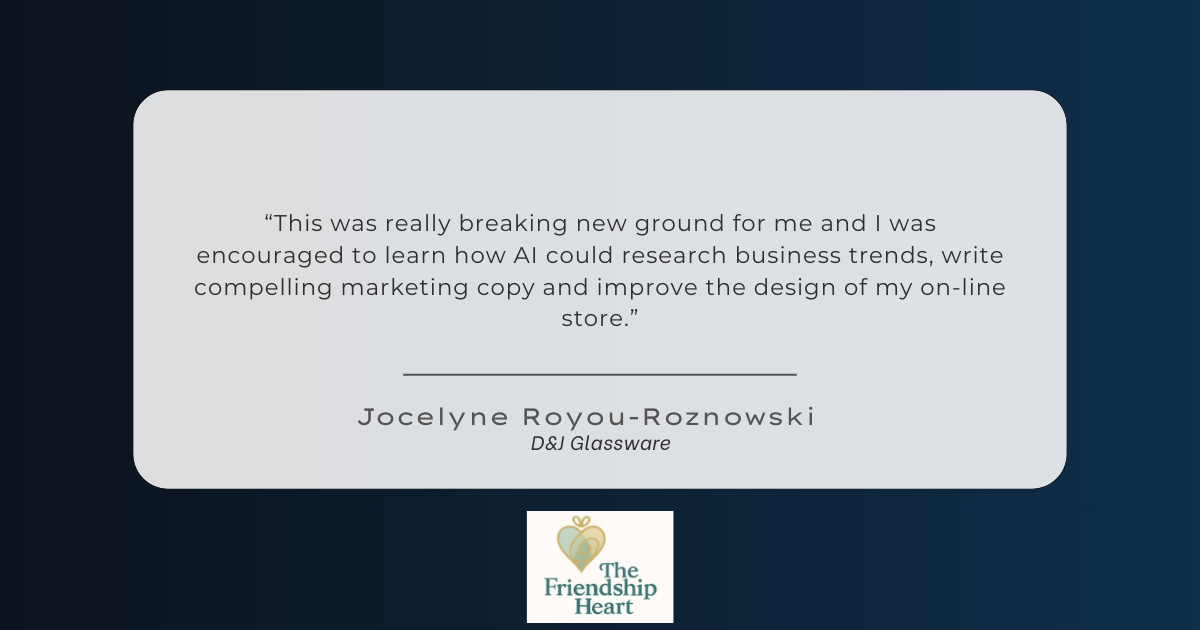
I was introduced to AI and shown how I could use various AI tools in my business. This was really breaking new ground for me and I was encouraged to learn how AI could research business trends, write compelling marketing copy and improve the design of my online store.
The sessions were very enjoyable and the enthusiasm was infectious. I now feel enabled to take things further and would certainly recommend this to anyone seeking to embark on their AI journey.”
— D&J Glassware
A practical starting point for SMEs
This work reflects a broader pattern we see across many small businesses.
AI becomes useful when it connects directly to real tasks.
Confidence grows when experimentation feels safe and manageable.
Learning sticks when people can apply it immediately inside their own work.
For SMEs, the goal is rarely “AI transformation.”
It is clarity, efficiency, and the ability to move forward with confidence.
That is where practical, grounded AI support makes the difference.
Curious how AI could help your business? Get in touch. We would love to explore it with you.

Favour Patrick
Favour Patrick has a background in economics and works in the product and AI space. Through product research, product thinking, content, and AI-enabled workflows, she tells stories about the people building better products and businesses
LinkedIn →